
Facility Management Operations
Deployed Today, Registered Tomorrow: Closing the Onboarding Gap in Facility Management
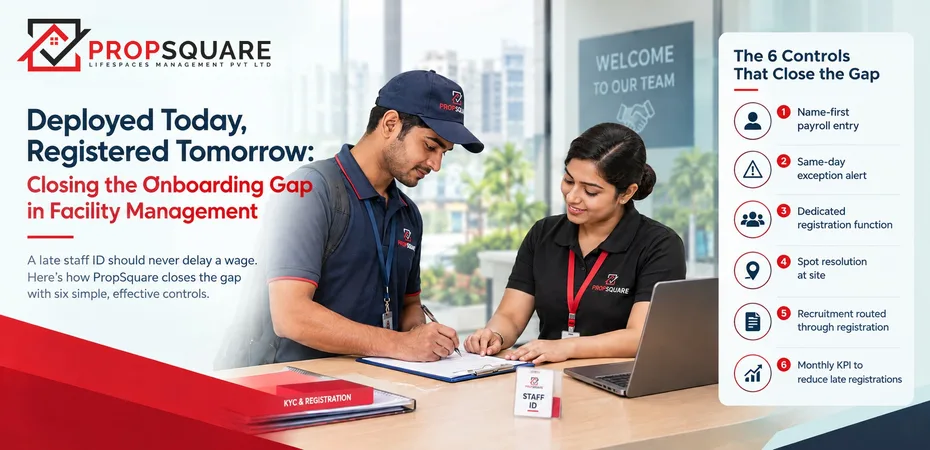
Every facility management operator in India knows this morning. A housekeeper does not report. The site supervisor needs a body on the floor by seven. Operations finds a replacement, the person starts, and the shift runs. Somewhere in that scramble, one small step is skipped: nobody told the registration desk. The person now exists on the muster but not in the payroll master. There is no staff ID yet.
That gap is not a sign of a badly run company. It is the structural by-product of how frontline FM works: high attrition, short-notice replacements, new-site go-lives, weekend joinings, and a workforce whose paperwork often lags behind their willingness to turn up. The question is not whether the gap happens. It is what your systems do when it does.
This piece is written for other operators, and for the committees and facility heads who buy from us. It sets out what a staff ID actually is, why the gap is a systems problem rather than a people problem, and the way PropSquare has redesigned its own process so that a late number never becomes a held salary, a cash payment, or an unnamed worker.
The rule we run to: the name never waits. The number can follow. Wages are computed from the first shift, under the person’s name, whether or not the staff ID exists yet.
What a staff ID is, and what it is not
Most operators generate an internal employee or Registration ID after onboarding KYC. The usual KYC document is Aadhaar, or another valid identity proof the operator accepts. That ID becomes the join key across the operator’s own systems: roster, daily muster, wage register, bank file, and any EPF or ESI record kept against the same name.
It is an operator key. It is not a government number. It is not an EPFO Universal Account Number, not an ESIC insurance number, not an Aadhaar number, not a PSARA agency licence, and not a Labour Department registration of the worker. When all of these collapse into the single word “registration”, a committee loses the file and an operator loses the argument.
Two of those government numbers now have clocks attached that every operator should know. Under the ESI scheme, a covered employee is to be registered within ten days of appointment; ESIC has issued circulars on delayed registration by employers. And since 1 August 2025, EPFO allots and activates UAN through the UMANG app using Aadhaar face authentication, which the worker does on an Aadhaar-linked mobile, with limited exceptions. That second change matters more than it looks. The UAN clock now depends partly on whether the worker’s own phone is Aadhaar-linked, which is one more reason a government number can lag behind a first shift, and one more reason the operator’s internal record cannot afford to.
Why the gap is a systems problem
Payroll software commonly makes the staff ID the join field. Attendance flows in against an ID; wages flow out against the same ID. If the field is empty, the run has nothing to join. Left to itself, the system does one of three unhelpful things with the person: parks the wage as “temporary”, pushes the shortfall to cash, or holds the salary until someone raises the ID.
All three are the wrong answer, and none of them is required by law. Under the Occupational Safety, Health and Working Conditions Code, the contractor is responsible for wages and payment is by bank transfer or electronic mode, where that Code applies. Under the Code on Wages, employment, muster, wage and wage-slip records must be kept, and those records need the worker’s name, not an operator’s private key. Cash is not automatically unlawful under the general wage rule, but “cash because the ID is pending” is not a documented fallback. It is an undocumented one.
The four Labour Codes took effect on 21 November 2025. Older central contract-labour forms remain a useful audit benchmark; they asked for the worker’s name and employment particulars, never for an operator ID as the condition of pay. Under the Telangana Shops and Establishments Act, where it applies, an appointment order is required before the employee joins. Ask any operator which current Code and state rules it is applying.
So the fix is not a memo to field teams to “remember the ID”. Field teams under pressure will always prioritise the floor over the form. The fix is to design the payroll and registration process so that a missed step is caught the same day, by a function whose only job is to catch it. (This is exactly what our managed payroll services are built to run.)
How PropSquare closes the gap
We rebuilt this process after living with the problem. Six controls now stand between a short-notice deployment and a missed wage.
1. Name-first payroll entry
Duties are logged into payroll against the person’s full name from the first shift, even when the staff ID field is blank. The system is configured to accept the record, not reject it. The wage clock starts on day one. (See how the muster itself gets captured in Attendance Tracking Made Simple.)
2. An automatic exception, the same day
The moment a duty is logged against a name with no staff ID, our internal application raises a flag to operations and to the registration function. Nobody has to notice it at month-end. The gap is visible on the day it opens.
3. A dedicated registration function
Registration at PropSquare is a separate department with its own managers and its own field team. It does not sit inside operations, payroll or front-desk administration. Its job is to own the person’s record from KYC to staff ID, and to chase every exception the system raises. Separating this function was the single biggest change: when registration belongs to everyone, it belongs to no one.
4. Spot resolution at site
When the flag fires, a registration field officer goes to the site, meets the worker on shift, completes or verifies KYC and generates the staff ID there. The person is not asked to come to an office. The record catches up with the worker, not the other way round.
5. Recruitment routed through registration
We have withdrawn on-site recruitment as a practice. Hiring routes through the registration function so that KYC and the ID are done before deployment, not after. Operations teams can still deploy a replacement directly in an emergency, and occasionally do. That is exactly the path the next control measures.
6. A KPI that has to fall every month
Every registration chase, meaning a deployment that reached payroll without a staff ID, is counted. That count is a monthly KPI with a month-on-month reduction target, reviewed with operations leadership. The KPI is the honest part of the system: it accepts that under real operational pressure the gap will sometimes open, and it makes closing it faster, and opening it less often, somebody’s measured job.
None of this needs a second ID system or a new register. It needs payroll to accept a name, a flag that fires the same day, and one team whose success is measured by how quickly the flag goes dark.
What this means if you are buying facility management
If you sit on a managing committee or run a facility, the useful lesson is not “demand a staff ID for everyone before the first shift”. Under real conditions that demand produces exactly the unnamed labour you are trying to avoid, because the replacement turns up anyway and simply stays off the record. The useful questions are about what happens when the ID is late:
- Is every person on site on the roster by full name from the first shift, with employer, role and shift?
- When a staff ID is missing, does the operator’s system flag it automatically, and who owns the chase?
- Is the person paid through payroll for those shifts, by bank or electronic mode, or does the wage drift to cash or hold?
- Can the operator show, worker-wise, UAN and ESI status where coverage applies, and explain any non-coverage?
- Does the operator measure late registrations, and is the number falling?
Write worker-wise UAN and ESI access into the work order as an express audit clause. Do not treat a staff ID as proof of KYC, EPF coverage, ESI insurance or paid wages. It is the operator’s linking key. Ask for the underlying evidence separately. (For the fuller buyer’s checklist, see our guide on how to choose a facility management company.)
An operator that answers those five questions well has understood the gap. An operator that insists the gap never happens has not looked.
This is general information, not legal advice. Confirm the specifics with the operator and with counsel.