Facility Management Operations
Society Maintenance Cost in India: In-House vs Outsourced Facility Management – The Real Comparison
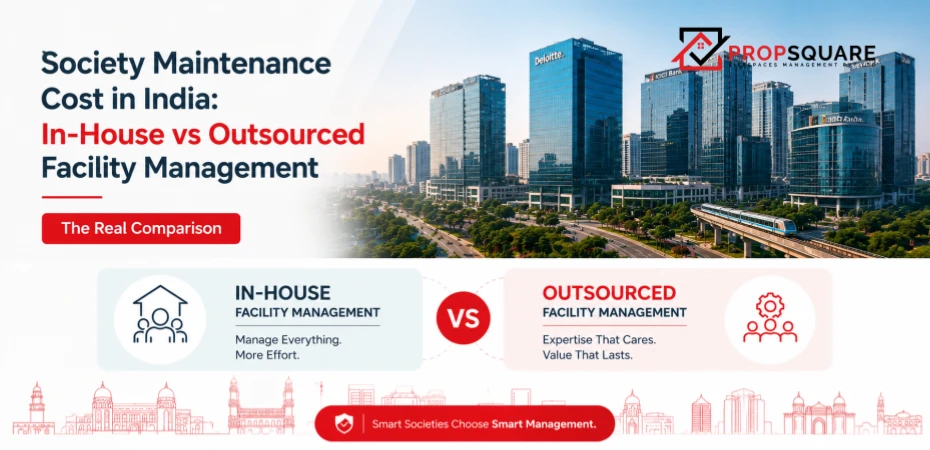
Every few weeks, a managing committee somewhere in Hyderabad asks me the same question: should we hire our own staff and run maintenance ourselves, or hand it to a professional facility management company? It usually surfaces right after a builder hands the society over, or after a maintenance bill jumps and residents start asking where the money goes. It is a fair question – and most committees are comparing the wrong numbers. They put salaries on one side, a contract fee on the other, decide that in-house “looks cheaper,” and discover the real cost a year later. Here is the comparison the way we wish every committee would run it before they decide.
First, what are you actually paying for?
Before comparing models, it helps to see where a society’s money actually goes. Across Indian gated communities, a maintenance budget breaks down roughly like this:
| Expense head | Share of budget | What it covers |
| Staffing (security, housekeeping, technicians) | 35–50% | Salaries, PF/ESI, uniforms, multiple shifts |
| Utilities (common-area power, water, DG) | 20–30% | Generators, lighting, pumps, sewage |
| AMC & technical maintenance | 10–15% | Lifts, CCTV, RO plants, STP |
| Waste management | 5–10% | Collection, segregation, composting |
| Management / FM fee | 5–10% | Agency or administration charge |
| Repairs & consumables | 5–8% | Plumbing, electrical, cleaning material |
The one point we want you to take from this table: manpower is half your budget. Whichever model you choose, you are really choosing how you want to hire, pay, supervise and stay legally compliant for a workforce. That is the heart of the in-house-versus-outsourced decision.
The in-house model – and the costs that never reach the salary sheet
On paper, running maintenance in-house looks cheaper. The society directly employs the guards, housekeeping staff, plumber and electrician, pays their salaries, and that is the number that goes into the budget. What the number leaves out is everything around the salary.
Industry research on facility management consistently finds that visible costs – salaries or contract fees – represent only about 60–70% of the true financial burden. The rest hides in supervision time, rework, staff turnover, compliance exposure and premature wear of assets, a hidden premium that can run to roughly 55% on top of the visible cost. In a housing society it shows up in three places:
- Committee time. In a self-managed society, supervision falls on volunteer committee members – chasing attendance, resolving complaints, managing vendors after work hours. That time is unpaid, but it is not free; it is the most common reason good committee members burn out and quit.
- Staff turnover. Frontline churn in this industry is high. Every time a guard or housekeeper leaves, someone re-hires, re-trains and absorbs the gap – a cost that quietly inflates the “cheap” in-house number.
- Asset wear. Inconsistent housekeeping shortens the life of flooring, lift interiors and common-area finishes – by up to 40% in studies of cleaning quality. Repainting and re-flooring a few years early is a real cost that never gets traced back to the staffing decision.
Add these up and in-house is rarely as cheap as the salary sheet suggests.
The compliance trap nobody budgets for
This is the part that worries me most when a society chooses to self-manage, because it is the part with legal teeth.
The moment a society puts staff on its own rolls, it becomes the employer in the eyes of the law – responsible for minimum wages, EPF contributions, ESI registration, bonus and gratuity, each with its own filing, deadline and penalty for getting it wrong. A security guard’s basic pay may look like ₹18,000–₹22,000 a month, but the fully-loaded cost with statutory contributions is meaningfully higher, and the paperwork sits with your committee.
Then there is GST. As reconfirmed by the Finance Minister in Parliament in July 2025, the rule is simple but unforgiving: if monthly maintenance exceeds ₹7,500 per member and the association’s annual turnover crosses ₹20 lakh, 18% GST applies – on the entire amount, not just the portion above ₹7,500. In Hyderabad, maintenance is also governed by the Telangana Apartments (Promotion of Construction and Ownership) Act, 1987 and RERA. A professional FM company handles staff statutory compliance under its own registrations, taking that liability – and the filing burden – off the committee entirely. That risk transfer is one of the most undervalued benefits of outsourcing.
What professional FM costs in Hyderabad – and what it actually saves
Let’s talk real numbers. In Hyderabad, monthly maintenance typically runs about ₹2–₹4 per sq ft in mid-segment communities (Miyapur, parts of Manikonda), ₹3–₹6 around Kondapur, and ₹4–₹7 in Gachibowli – climbing to ₹6–₹10 in premium pockets and as high as ₹25 per sq ft in ultra-luxury gated communities. For a 2BHK that is roughly ₹2,400–₹8,400 a month; for a 3BHK, ₹4,000–₹12,600, depending on location and amenities.
A professional FM provider does not automatically make that number bigger. Research by JLL India finds organisations that move to outsourced FM achieve up to 20% cost savings and 10–15% operational efficiency gains over a multi-year contract – by converting fixed employment overheads into a managed variable cost and bringing the buying power, trained manpower and preventive-maintenance systems a single society cannot build on its own. Preventive maintenance is where the saving really comes from: planned upkeep costs a fraction of emergency work, and uncoordinated ad-hoc callouts can cost several times more per event than the same job under a managed plan.
A simple way to compare by society size
Here is the framework we give committees:
| Society profile | What we recommend | Typical cost (per flat / month) |
| Under 50 flats, simple amenities | Volunteer committee + outsource security & housekeeping | ₹2,000–₹4,000 |
| 50–200 flats, moderate amenities | Professional FM with retained committee oversight | ₹3,500–₹8,000 |
| 200+ flats, or clubhouse / pool / multi-tower | Full professional FM under a clear SLA | ₹5,000–₹15,000 (location-dependent) |
Notice the inflection point. Below roughly 80–120 flats, a committee can hold things together with selective outsourcing. Above it – once you have lifts, a clubhouse, a pool, an STP and a few hundred families – the sheer volume of compliance, vendor management and complaint resolution outgrows what volunteers can sustainably handle. That is exactly where self-management quietly breaks down.
Our honest take
After years of running operations across Hyderabad communities, I’ll say it plainly: for any society past the smallest tier, professional facility management is the better decision – not because it is always the lowest line item, but because it is the lowest true cost. You stop paying the hidden 55%. You transfer statutory and GST liability to a registered provider. You replace informal, burnout-prone volunteer supervision with SLAs, scorecards and monthly reporting you can actually hold someone accountable to. The control you think you give up by outsourcing is replaced by a better kind of control – control through accountability rather than through a payroll you have to police yourself.
Compare total cost of ownership, not the salary sheet. When committees do that honestly, the answer almost always points the same way.
Want this run for your community? We’ll prepare a tailored quote and a total-cost comparison for your society – no obligation. Write to sales@propsquares.com, call +91 – 799 3333 990, or request a quote at propsquares.com.