

PropSquare LifeSpaces Management • 17 May 2026 • Operations · Workforce · Technology
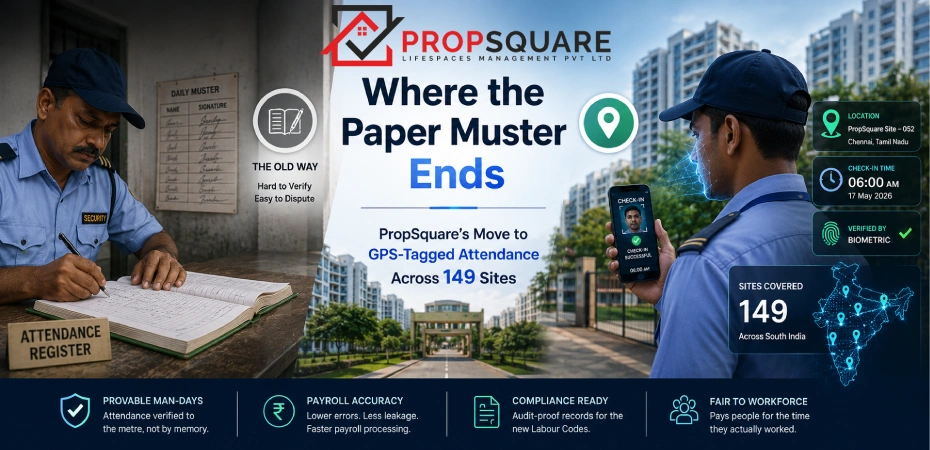
Where the Paper Muster Ends: PropSquare’s Move to GPS-Tagged Attendance Across 149 Sites
For most of facility management’s history in India, the attendance register has been a green-cloth-bound ledger sitting on a supervisor’s table. A housekeeping team member walks in, scribbles a signature, and the supervisor counters it with initials. At month-end, those pages become a paysheet. The paysheet becomes a client invoice. The client invoice becomes a question — were these people actually here?
That question is the one PropSquare’s transition to digital attendance is built to answer with certainty. As of today, twenty-four percent of attendance across our 149 sites is captured digitally — geo-tagged, time-stamped, biometrically verified. The remaining seventy-six percent is still on paper. We are publishing this post in the middle of the journey rather than at the end of it, because we believe the most useful conversation our industry can have right now is an honest one.
Why the entire industry is moving — not just us
The shift is no longer optional. On the twenty-first of November 2025, India’s four new Labour Codes came into force, replacing twenty-nine separate laws and mandating electronic registration for any establishment with ten or more employees. The Shram Suvidha portal now expects auditable digital records on wages, attendance, and statutory contributions, and non-compliance penalties under the new Codes range from fifty thousand rupees to ten lakhs per violation. For an integrated facility management company operating across South India’s largest metros, paper musters and quarterly reconciliation are no longer a defensible position.
The economics push in the same direction. Industry research consistently puts the error rate in manual time-and-attendance systems at between fifteen and twenty-five percent, while automated systems bring that error rate below two percent. The American Payroll Association estimates that time theft and buddy-punching alone cost organisations up to seven percent of total payroll, and that seventy-five percent of businesses are affected by it. India’s facility management market is growing from roughly eighty billion US dollars in 2025 to a projected one hundred and twenty-four billion by 2031, with soft services like housekeeping and security — labour-intensive, multi-site, shift-based — making up two-thirds of that revenue. The companies that win this decade will be the ones whose books can be reconciled to GPS coordinates, not to handwriting.
What gets unlocked when attendance goes digital
The benefits we are already witnessing in our digitised twenty-four percent fall into four buckets, and each one matters to a different stakeholder.
For our clients — the Management Committees, builders, and corporate facility heads who pay our invoices — the most visible change is that man-days deployed at their site are now provable to the metre. A geofence drawn around a community of one and a half lakh square feet means our security guard punching in at six in the morning is verifiably standing inside the gate, not outside the gate, not at another site, not on the road. When the next month’s invoice lands, the supporting register is a tamper-evident digital log rather than a photocopied page. Disputes over manpower deployment, which were once the single largest source of friction in client meetings, are beginning to resolve themselves before they begin.
For our finance team, payroll processing time has compressed significantly on the digitised sites. Where reconciliation between site registers and central payroll once took the better part of a fortnight, the same volume now closes in days. We are not yet ready to publish a final ROI number — twenty-four percent is too early for that — but the directional pattern matches what global case studies have consistently shown: half the processing time, a measurable reduction in over-billing and under-billing, and a payroll error rate that has fallen towards the under-two-percent benchmark.
For compliance and audit, the digital trail produces what the new Labour Codes effectively demand: a continuously updated record of who worked, where, for how long, at what wage, with PF and ESI computations defensible against any inspector or portal validation.
And for our own workforce — perhaps the most important group of all — digital attendance is starting to do something the paper register could never do. It pays them for the time they actually worked. The supervisor who could mark a guard absent on a whim, or grant a friend an extra hour, has been quietly removed as a single point of failure.
The part that no one talks about: this is genuinely hard
If digital attendance were simply a matter of buying software and rolling it out, every facility management company in India would already be at one hundred percent. We are not. No one is. And the reasons are worth being honest about.
The first reason is the workforce itself. According to the IAMAI-Kantar Internet in India 2024 report, thirty-eight percent of Indians remain non-internet users, eighteen percent of internet users share devices rather than owning them, and rural mobile penetration sits at under sixty percent compared to one hundred and twenty-five percent in cities.
The second reason is technical. GPS applications drain between thirteen and thirty-eight percent of a phone’s battery during a continuous shift.
The third reason is trust. India’s Digital Personal Data Protection Act of 2023 covers every employee as a Data Principal, with penalties extending up to two hundred and fifty crore rupees per violation.
The fourth reason is the simple arithmetic of change management. McKinsey’s research, repeated across studies by Bain, BCG, and KPMG, finds that roughly seventy percent of digital transformations fail to meet their stated objectives.
What we are doing differently
Our rollout is phased on purpose. We are running paper and digital in parallel on every newly onboarded site for at least one full payroll cycle, so that no team member sees their wage disrupted by a system they did not yet trust.
We expect the last twenty percent of digitisation will be harder than the first eighty, and we are budgeting for that asymmetry.
What this means for our clients
If you are an RWA, a Management Committee, a builder, or a corporate facility head reading this: the invoice you receive from PropSquare next quarter will increasingly be a document you can verify, not a document you have to take on faith.
Twenty-four percent today. One hundred percent is the destination. But getting there with our workforce — and with our clients in the loop on every step — is the only version of this transition worth doing.
PropSquare LifeSpaces Management Private Limited manages 149+ residential and commercial sites across South India. For questions on our digital attendance rollout or our broader operations stack, write to
admin@propsquares.com.